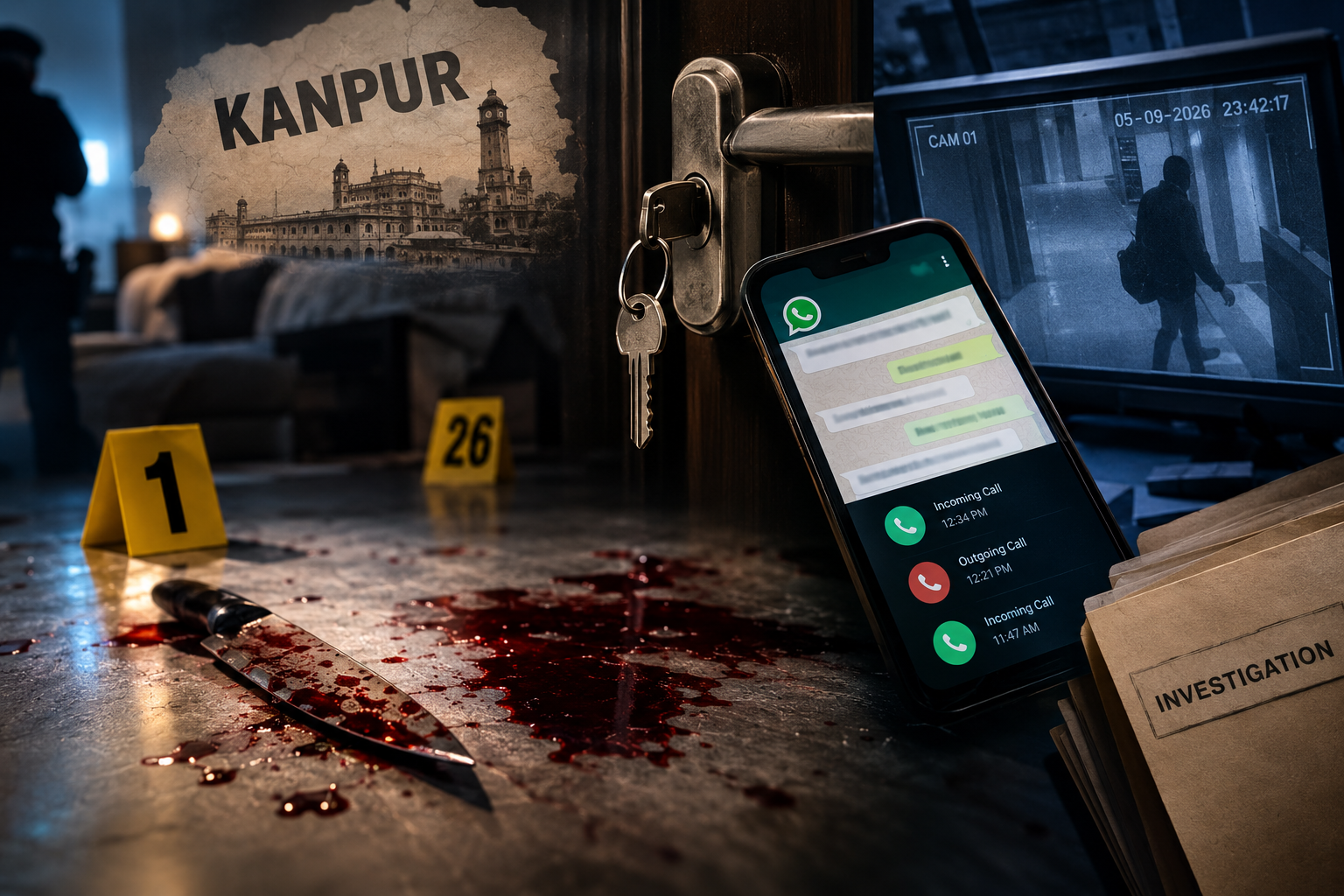
The murder of Kanpur-based medicine trader Vineet Minocha has raised serious questions about family disputes, criminal conspiracy, digital evidence and the role of electronic communication in modern criminal investigations. The businessman was reportedly found murdered inside his residence in Kanpur, with multiple stab wounds, while the initial circumstances surrounding the incident led investigators to examine the possibility of a planned attack.
As the investigation progressed, police reportedly examined CCTV footage, call records, WhatsApp communications and the movements of people connected with the victim. The case has therefore become significant not only because of the nature of the alleged crime but also because of the role played by digital and circumstantial evidence in uncovering the sequence of events.
Note: The allegations and investigative findings discussed in this article are based on media reports and information attributed to the police investigation. The guilt of any accused person is ultimately to be determined by the competent court.
1. What Happened in the Kanpur Medicine Trader Murder Case?
According to media reports, 63-year-old medicine businessman Vineet Minocha was allegedly murdered at his residence in Kanpur during the night of September 5–6, 2026.
Reports state that Minocha was alone at home at the time of the incident. His family members had reportedly gone out and the discovery of his body subsequently led to a police investigation.
The severity of the attack immediately raised suspicion that the incident may not have been a simple robbery or spontaneous assault. More than 26 stab wounds were reportedly found on the victim’s body, prompting investigators to examine whether the murder had been planned in advance.
The investigation subsequently shifted towards people known to the victim and individuals who may have had access to the residence.
2. Why Did the 26 Stab Wounds Make the Case More Serious?
The number and nature of injuries became an important part of the investigation.
Reports indicate that the victim suffered more than 26 knife injuries. Such injuries can become relevant in a criminal investigation because investigators examine factors including the nature of the weapon, location of injuries, timing of the assault, blood patterns, forensic evidence and the possible intention behind the attack.
The medical and forensic evidence can help investigators reconstruct the sequence of events and determine whether the death was consistent with the statements given by suspects or witnesses.
In a criminal trial, however the mere number of injuries does not by itself establish the guilt of a particular person. The prosecution must establish the complete chain of evidence through admissible evidence presented before the court.
3. The Mystery of the Duplicate Key
One of the important aspects reported in connection with the investigation is the question of access to the residence.
When a serious offence occurs inside a private residence, investigators generally examine how the accused could have entered and exited the premises. A duplicate key, if established through investigation, can become an important circumstantial link because it may help investigators determine whether there was prior planning or familiarity with the property.
The alleged use or availability of a duplicate key therefore became one of the elements examined during the investigation.
However, access to a property alone does not establish criminal liability. Investigators and prosecutors must connect such evidence with other circumstances, such as communication records, CCTV footage, witness statements, forensic material and the conduct of the persons involved.
4. What Did the WhatsApp and Call Records Reveal?
One of the most significant developments in the case has reportedly been the examination of digital communication records.
Police reportedly examined phone records and WhatsApp communications involving people connected with the case. Media reports have highlighted repeated communication between the accused persons and a former employee around the period preceding the murder.
Some reports state that there were multiple calls between the victim’s son and the former employee, while communication between the son and his wife was also examined. Other reports have referred to deleted WhatsApp messages and frequent phone contact between the daughter-in-law and a former employee.
These records became relevant because investigators were attempting to determine whether there was communication between the persons allegedly connected with the incident before, during or after the crime.
Digital communication can be particularly important in a modern criminal investigation because it may help establish:
- Communication between suspected persons
- The timeline preceding an alleged offence
- Contact between individuals before and after an incident
- Possible coordination between persons
- The location or movement of individuals when supported by other evidence
- Whether statements made during investigation are consistent with available digital records
At the same time a phone call or WhatsApp message does not automatically prove a criminal conspiracy. The context, authenticity, chain of custody and connection of the communication with the alleged offence must be established.
5. Was the Murder a Planned Conspiracy?
The investigation reportedly began examining the possibility that the murder was not spontaneous but had been planned.
Police have reportedly alleged that the victim’s daughter-in-law had disagreements with him, including disputes relating to financial control, household restrictions and privacy. Investigators also reportedly examined the involvement of a former employee and other persons.
According to media reports, CCTV footage and communication records played a role in directing the investigation towards individuals known to the victim.
The police investigation is therefore focused on establishing whether there was a coordinated plan, who allegedly participated in it, what their respective roles were and whether the available evidence can establish a criminal conspiracy.
Under criminal law, proving conspiracy generally requires more than showing that two people communicated with each other. The prosecution must establish the necessary legal ingredients through admissible evidence.
6. The Role of CCTV and Digital Evidence in the Investigation
The Kanpur murder investigation also demonstrates the increasing importance of electronic evidence in criminal cases.
CCTV footage can help investigators establish the movement of individuals around a particular location. Similarly, call detail records, messages and other electronic data may help establish communication patterns and timelines.
However, electronic evidence must satisfy applicable legal requirements before it can be relied upon by a court.
The Bharatiya Sakshya Adhiniyam, 2023 (BSA) provides the current legal framework governing evidence in India and contains provisions dealing with electronic and digital records.
Therefore, investigators cannot simply rely on a screenshot or an isolated message. Questions relating to authenticity, source, integrity, preservation and the manner in which electronic evidence was obtained and produced before the court can become important during criminal proceedings.
7. What Legal Questions Arise from the Case?
The case raises several important legal questions beyond the immediate facts of the murder.
A. Can Digital Communication Establish Criminal Conspiracy?
Phone calls and WhatsApp messages may become important circumstantial evidence, particularly when they form part of a larger chain of events.
However, communication between two persons by itself does not necessarily establish conspiracy. The prosecution would need to establish how the communication connects with the alleged criminal act.
B. What Is the Evidentiary Value of CCTV Footage?
CCTV footage can be significant in establishing the presence or movement of individuals. Its evidentiary value may depend upon factors such as authenticity, proper preservation and compliance with applicable evidentiary requirements.
C. How Are Deleted WhatsApp Messages Investigated?
Deleted messages may sometimes become relevant during a digital forensic investigation. Investigators may examine available device data and other technical evidence, subject to applicable law and forensic procedures.
The mere deletion of a message, however, should not automatically be treated as proof of guilt. Its relevance depends on what the investigation is able to establish regarding the message, its context and its connection with the alleged offence.
D. Can Circumstantial Evidence Be Sufficient in a Murder Trial?
Yes, a criminal case can, in appropriate circumstances, be based substantially on circumstantial evidence. However, the circumstances relied upon by the prosecution must form a complete and legally sustainable chain pointing towards the guilt of the accused and excluding reasonable alternative explanations.
8. Why This Case Highlights the Importance of Electronic Evidence
Traditional criminal investigations often depended heavily on eyewitnesses, physical evidence and statements of witnesses. Modern investigations increasingly involve another category of evidence: digital evidence.
Mobile phones, CCTV systems, call records, messaging applications and other electronic sources can provide investigators with valuable information about a person’s movements and communications.
But digital evidence also presents legal challenges.
Evidence must be collected, preserved and presented in accordance with the applicable legal framework. Any issue concerning authenticity, tampering, incomplete data or improper handling may become relevant during court proceedings.
The Kanpur case therefore illustrates how criminal investigations today can involve a combination of:
- Forensic evidence
- Medical evidence
- CCTV footage
- Call detail records
- WhatsApp and other electronic communications
- Witness statements
- Circumstantial evidence
- Physical evidence from the crime scene
The strength of the prosecution case ultimately depends on how these individual pieces of evidence connect with one another.
9. Investigation Versus Proof in Court
A crucial distinction must be maintained between a police investigation and a judicial finding of guilt.
Police may arrest a suspect or identify a person as an accused based on the material available during investigation. However, an arrest or allegation does not amount to a conviction.
The prosecution must prove the charges before the competent court in accordance with law. The accused is entitled to the protections available under criminal procedure and evidence law, including the principle that guilt must be established through legally admissible evidence.
This distinction is particularly important in high-profile criminal cases, where media reports and public discussion can sometimes move faster than the judicial process.
10. Conclusion
The Kanpur medicine trader murder case has attracted attention because of the alleged brutality of the attack and the subsequent investigation into the involvement of people known to the victim.
The reported use of CCTV footage, phone records, WhatsApp communications and other forms of digital evidence demonstrates the growing importance of technology in criminal investigations.
At the same time, the case highlights an important legal principle: suspicion, allegations or isolated digital records cannot by themselves replace proof before a court. The prosecution must establish the relevant facts through legally admissible evidence and demonstrate the required criminal liability in accordance with law.
As the investigation and judicial proceedings progress, the role of forensic evidence, electronic records, witness statements and circumstantial evidence will remain central to determining what actually happened and whether the allegations can ultimately be proved before the court.
Disclaimer: This article is intended for general informational purposes only and does not constitute legal advice. The facts discussed are based on publicly available media reports concerning the ongoing investigation and may change as further information becomes available or as the matter progresses before the competent court.